How to make your communication more mobilizing and strategic
Let’s go through some quick tips to win more votes in your electoral campaign? These 14 tips will help you win votes by making your electoral and political communication much more mobilizing and strategic.

1. If you don’t mobilize emotions, you don’t mobilize anything.
There is a saying in political communication that goes: sell the brownie, not the recipe. The story to be told is how the brownie is connected to well-being, emotional memory, and happiness; not the recipe, such as quantities of eggs, butter, and flour. Mobilizing emotions does not mean creating a completely fanciful narrative. It is possible to mobilize emotions while also making tangible proposals connected to real life, as it should be.
See the example of Alexandria Ocasio’s campaign in the United States, in 2019.

2. Show that your campaign is full of mobilized people.
Seeing lots of people together in a campaign makes more people want to join. This also reinforces that your candidacy is a collective one. Little by little, you create a herd effect, and people join when they see others coming together.

3. Tell your story by connecting with your audience.
When you talk about yourself, you also talk about the world you live in. Show how your story connects with those of so many other people. People connect through stories and need to identify with them. Remember the “story of self, story of us, story of others” framework on the public narrative guide.

4. Research and measure everything you can.
Often, we spend time and invest resources during the fast pace of a campaign without even knowing whether that communication is actually working. There are many free tools (even from the platforms themselves) that show the metrics for each piece of content. Pay attention to these metrics, learn from them, discard what doesn’t work and go deeper into what worked.

5. Be open and show people the paths to engage in the campaign.
Present scalable and progressive actions that people can take, such as:
- joining a WhatsApp/Telegram group,
- receiving calls to action by email,
- sharing content on social media,
- receiving and distributing materials in their territory, or
- volunteering for the campaign.
In WhatsApp groups, it’s also possible to create daily or weekly missions for those who are more engaged, such as: convincing the vote of three people you know, talking to people at work or university, securing five donations for the campaign, and so on.

6. Spread your poll number and your face everywhere.
Whether in the profile photo, username, stickers, flyers, and especially in the jingle, the poll number needs to be present and highlighted.

7. Breaking point: bring elements that humanize the candidate.
In general, people tend to have a not-so-favorable view of politicians. Try to lower barriers by introducing a breaking point; real characteristics and habits of the candidate that help humanize her and connect with the audience. It’s very important that these habits are real and not forced (like the classic politicians eating pastries at street markets during campaign season).

8. The candidate doesn’t always have to be the protagonist. Personas are your allies.
Some pieces can focus more on personas, figures that symbolize certain segments of the campaign’s audience. Sometimes this is much more effective than showing the candidate in a situation that feels forced. It also shows that your candidacy represents a broader collective.

9. Map networks of amplification and influence: public figures, movements, and collectives.
Over the years, we (and the people who build campaigns) create networks and bonds with many people: public figures from parties, movements, and collectives. These actors help expand the reach of our communication and amplify many actions. Be sure to map them (for example, in a spreadsheet) and activate them to create waves of shared content or even suggest support videos for the campaign. This is an exercise for everyone in the campaign to do whenever you have key messages to spread.

10. Boost content strategically.
Today, ads on social media are very common, but thinking about boosting in political communication means defining which type of content should be promoted so that the goal is engagement and channeling those who receive the content toward a call to action.
So it’s worth boosting major campaign pieces, such as a video featured in the candidate’s bio or the campaign’s concept video, as long as the ad text includes a way for people to engage, such as inviting them to learn more by visiting the website or signing up to receive campaign further calls to action. Another type of content to boost for engagement is an invitation to a rally or campaign event, directing people to participate in a gathering.

11. Try out-of-the-box engagement tactics.
In the rush of everyday life, we sometimes run on autopilot and forget to activate our creativity. Thinking about different engagement actions and tactics, especially in-person ones, helps lower barriers with potential voters, activate playful elements, and spark the imagination around what we want to mobilize.

12. Answer to questions and comments, but don’t feed the trolls.
Always interact with people, whether to thank and celebrate support or to answer questions. This is important for converting those who are undecided or simply repeating something they heard. Also show that real people are responding, not an institution. Even bots (virtual robots) imitate people. Especially during a crisis, it’s crucial to respond quickly, transparently, consistently, and using concrete examples.

13. Build your theory of change and the narrative thread of your campaign.
Narrative is the heart of political communication. It is the framework for the story we will tell to mobilize emotions. Building a collective journey narrative that begins by presenting the context and challenges and shows the paths to solving these problems helps engage and persuade your audience. For this, it’s important to create a sense of cause and effect; meaning that we will only reach the solution if people join in and act together. Below are examples of how you can help build the collective journey and the theory of change.
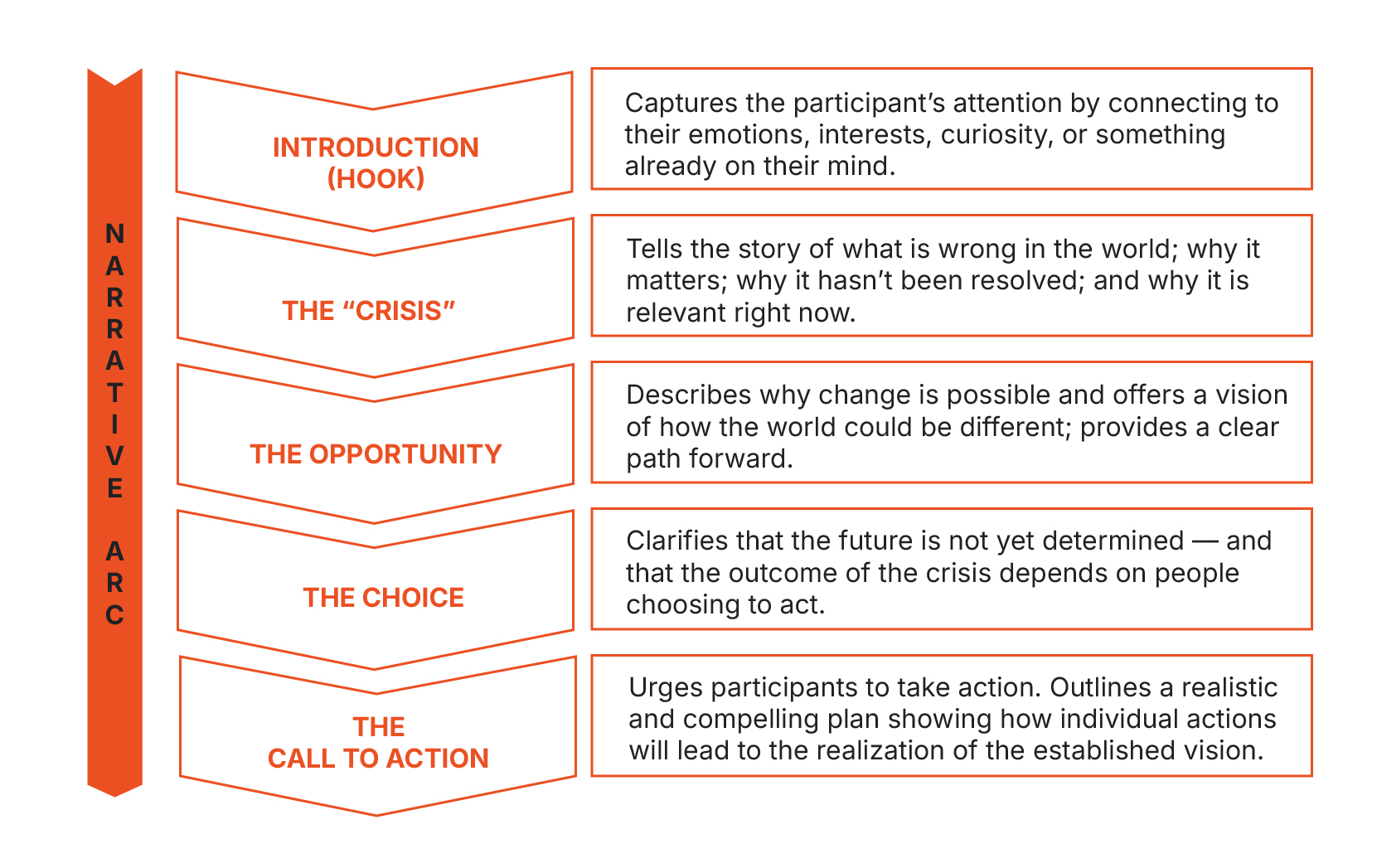

14. Don’t forget the invitation; always end with a call to action.
When ending your narrative and building your theory of change, always make an invitation (aka “call to action”). Making this call directly contributes to people’s engagement and helps achieve the mobilization goal we want. There is an engagement curve that crosses time and effort, as shown in the graph below, which you can gradually build with the network of people and volunteers who support the campaign. As time goes by, you can increase the level of complexity of the call to action.