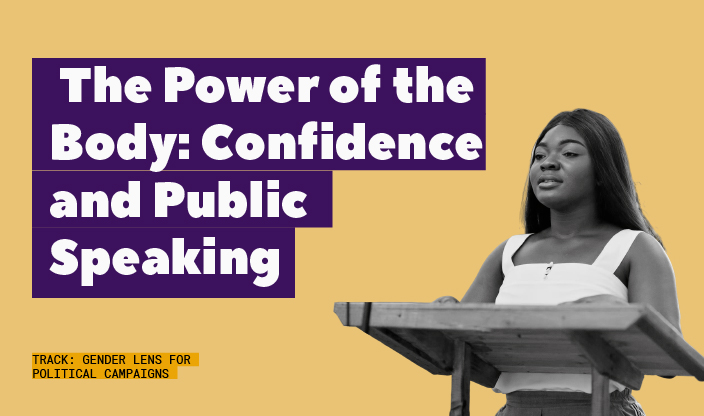
Strategies for women to project power without conforming to masculine norms
Are you afraid of speaking in public? Does the idea of giving a speech in front of hundreds or thousands of people make you anxious? Do you feel that others don’t believe you are able to wield public power? Do you struggle to answer questions about your age, physical appearance, or personal life? Almost all women experience this. You are not alone.
What is political communication?
It’s a field of communication focused on making a person’s capacity to exercise authority visible, strengthening their leadership, and communicating their ideas in ways that convince, influence, and persuade.
The problem is that the very concept of what power is has been designed through a masculine lens. Women were not only excluded from power; but the idea itself was also forged so that everything considered feminine lacks power, while everything considered masculine represents power.
Take, for example, the tone of voice in political speeches. Even today, a low-pitched/deep tone is widely perceived as conveying authority – a quality generally associated with men’s voices. Notably, even the term “deep” alludes to serious, important things. This is not the case with the high-pitched tone that women generally have.
Political communication through a gender perspective takes these dynamics into account and offers strategies that enable women to communicate power without having to masculinize themselves.
Why is it so difficult?
Historian Mary Beard explains that, in Western literature, the first documented example of a man silencing a woman appears in Homer’s Odyssey, almost 3,000 years ago.
That epic poem recounts the adventures of Odysseus (Ulysses) on his journey back to his homeland, Ithaca, after the Trojan War. In one passage, Penelope (Odysseus’s wife) comes down from her chambers and listens to the poet singing about the hardships endured by heroes on their return home. She then asks him, in front of those present, to change the subject and choose a more cheerful one.
At that moment, her adolescent son, Telemachus, intervenes:
“Mother, go back inside the house and attend to your proper tasks, the loom and the spindle… Storytelling (that is, public speech) will be the concern of men, and above all mine. For mine is the rule of the household.”
Both in Greek mythology and in Roman historical records, there are numerous examples of women being silenced or publicly humiliated for daring to speak in public.
Afrania, for example, who acted as a legal advocate in court cases, was described as “shameless” and accused of exhausting people with her “barking or growling.”
The right to speak publicly was granted only to victims, such as Lucretia (who spoke before taking her own life after accusing her rapist) or Hortensia (who spoke on behalf of other women facing higher taxes to fund the war). “Women’s matters,” they thought.
But in political affairs (those concerning citizenship) women had no voice and were not supposed to have one. Those who dared to speak – and many did, we always have – were subjected to ridicule, humiliation, and even violence (real or symbolic).
In the nineteenth and twentieth centuries, across much of the Western world, suffragists took over public spaces to demand the right to vote. They were censored and even imprisoned. Anti-suffrage posters in the United States reveal what many believed should be done to women who dared to speak publicly to claim their right to vote.
This history of silencing, ridicule, humiliation, violence, and exclusion from public power is the story of women around the world throughout different eras. It is the story of many women even today.
And yet, here we are. Claiming our right to hold power and transforming the very idea of what that means. We haven’t finished climbing that mountain.We haven’t even begun. Let’s keep going.
If you’d like to learn more about the history of women ‘s public voices, I recommend Mary Beard’s book, Women and Power, published in Spain by Crítica in 2018. You can also watch the following interview with Mary Beard:
Disclaimer: Our global content is produced from the knowledge network of many different people and geographies. Always research the rules applicable to your specific territory and ensure that your activities comply