
Im.pulsa

Planning Your Political Campaign
Why Strategy Matters
 GLOBAL
Guides
GLOBAL
Guides

Electoral campaigns to transform reality
When we talk about electoral campaigns capable of changing reality, we’re talking about situations in which political action is placed at the center of the process, as a tool for social transformation. In this context, electoral campaigns are understood as instruments for dialogue and articulation, and can be seen as catalysts for change.
In an electoral campaign, turning objectives into reality is the core goal of the strategy, and the strategy is the core tool to make it happen.
Political campaigns represent an opportunity to talk and engage with people about our political project. Political campaigns also make it possible to contrast opinions and arguments, organise groups around a specific objective, connect and bring more people together, and mobilise them around shared beliefs in society.
Campaigns are moments when institutional forces come together, disputing and shaping a future political and social scenario. Political temperature rises, and as a result, people are more driven to demand action and to engage.
Where do campaigns happen? And why does strategy matter?
Where do we meet voters and build relationships with them? This space can be divided into two broad categories, which we’ll call “air” and “ground.”

Air: billboards in public spaces, social media advertising, TV slots, radio ads… We can define “air” as everything that reaches people through the public sphere, but not necessarily through a specific or personal interaction.

Ground: here we include phone calls as part of one-to-one connection. Face-to-face contact with voters ,canvassing, neighborhood meetings, etc.
Is one more important than the other? That depends on the campaign strategy.
All actions and messages in the “air” sphere enable mass communication. They increase visibility, set the campaign tone, and project the candidate’s image into the public space.
Interaction on the “ground,” however, is decisive for voter mobilisation. It’s through direct contact that real, specific interaction happens. It allows conversations tailored to voters’ concerns, builds reciprocal relationships through listening and participation, and opens space for incorporating new voices, ideas, and campaign participants.
Every campaign has a strategy
Strategy is the filter that determines all our actions during the campaign, because it aligns the efforts of the teams and guides all decision-making. That’s why it’s essential that everyone involved has a clear understanding of it.
Strategy must reflect the political objectives of the campaign. It’s not a slogan, nor simply the number of votes we need to win. It’s a synthesis of the positioning we want to project. That’s strategy.
Anyone developing an electoral strategy should take the following into account:

Current legal regulations:
Campaign spending, campaign periods, candidate registration, and the electoral system that governs the election. Check all the rules that apply to your specific context.

Electoral analysis:
How many votes are needed to win or achieve the campaign’s political objectives? Where can those votes be found?

Information about the electorate:
Using quantitative and qualitative methods and research, such as focus groups or in-depth interviews, try to understand what they care about and what repels them.

Information about other candidates:
Who they are, their backgrounds, and the values and actions people associate with them.

Information about the territory:
Its organisations, history, and stakeholder map.
After gathering this information, other strategic inputs should be built, such as group dynamics to define why, how, where, and how we want others to see us; how they see our opponent; and what kind of image we want to project – this should afterwards be reflected on the visual id, style guide and all communications.
It’s important to emphasise that not only the outcome of this exercise matters, but also the discussion and conversation it generates. This process helps align expectations, contrast different views within the campaign team, and bring in richer, more nuanced elements towards to the campaign’s efforts.
Disclaimer: Our global content is produced from the knowledge network of many different people and geographies. Always research the rules applicable to your specific territory and ensure that your activities comply
Campaign Planning Essentials
GLOBAL
Guides

Electoral campaign’s stages and planning
We recommend that the strategy development considers processes, timelines, and leaders. That’s why, within campaign teams and processes, it’s important to have people who can carry out different tasks. Let’s take a look.
Basic notions for planning an electoral campaign and identifying its main stages
Intuitively, especially in highly politicised environments, there’s often an excessive concentration of skills and “person-hours” in strategy and political negotiation. At the same time, there’s little focus on tactical and operational deployment. In less politicised campaigns, the opposite tends to happen: strong operational focus with weak strategic alignment.
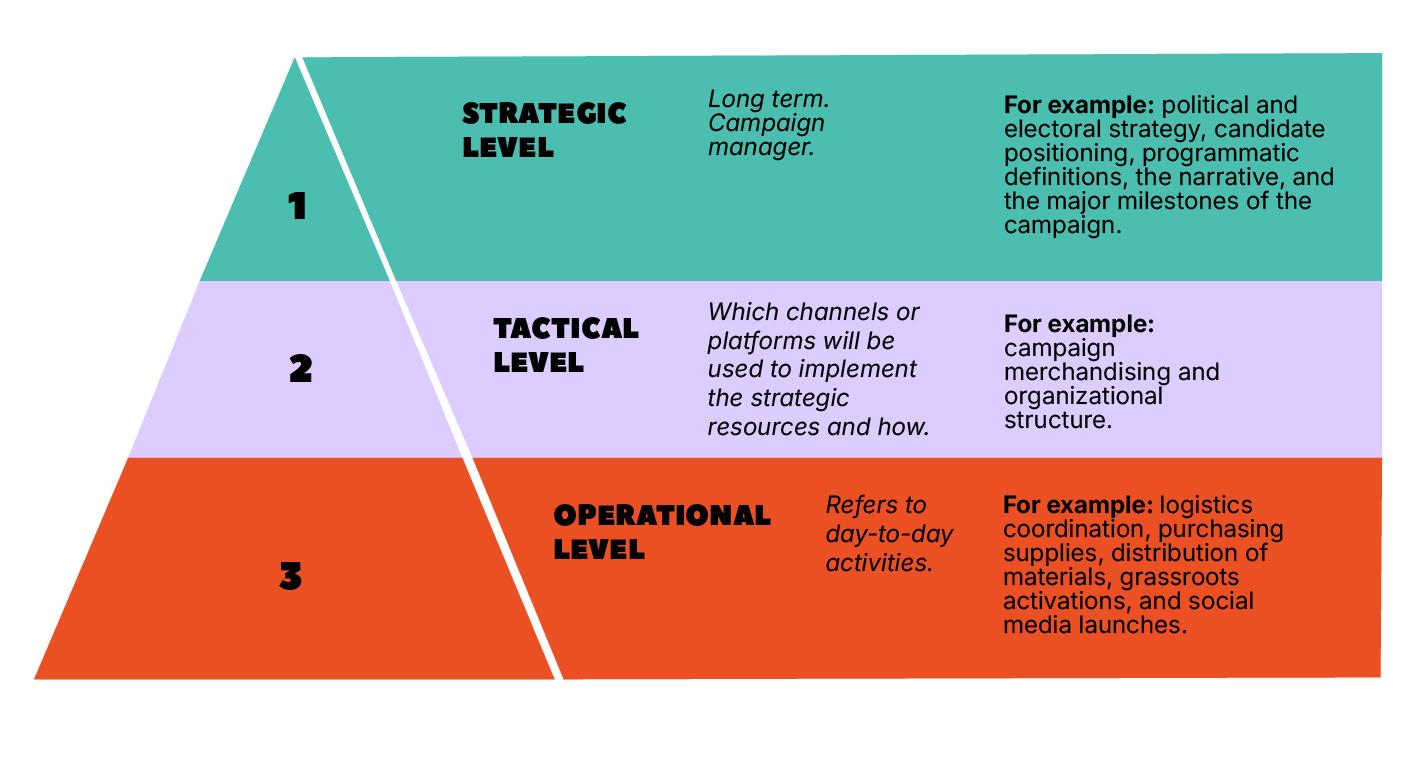
That’s why it’s important to recognise and become familiar with the three levels of strategic planning:
01
Strategic level:
This level corresponds to the most general, high-level definitions of the campaign. It guides long-term decisions. For example: the political and electoral strategy, the candidate’s positioning, programme causes and definitions, the campaign narrative, and its major milestones.
02
Tactical level:
This refers to the tactical unfolding of the strategy. It defines which channels or platforms will be used to carry out strategic actions and with which resources (the budgeting process usually sits at this level). Campaign advertising choices and even the organisational chart belong here.
03
Operational level:
This concerns the day-to-day activities that implement the tactical plan, such as logistics coordination, procurement, material distribution, territorial activations, and social media outreaches.
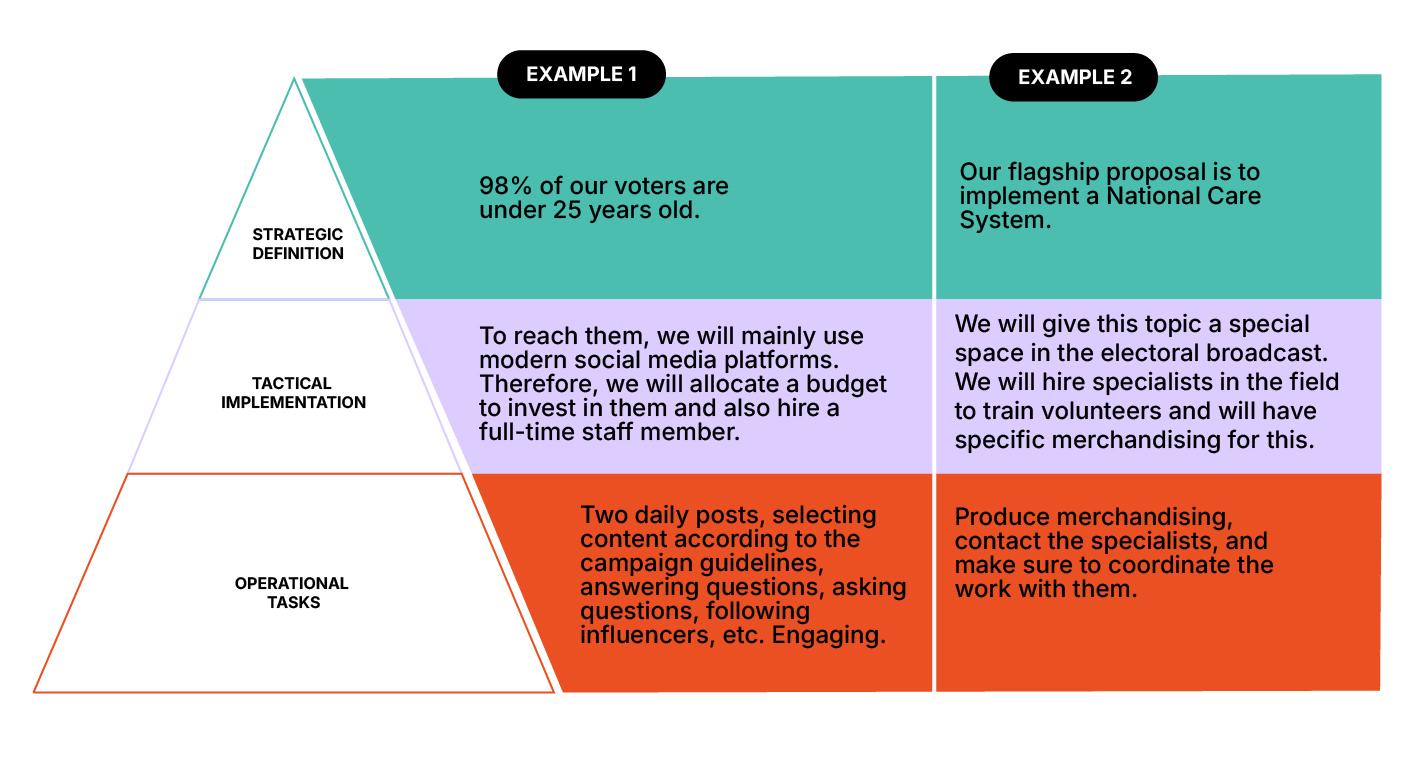
In the table below, you’ll find two examples of strategic definitions along with their tactical implementation and associated operational tasks:
| Strategic definition | Tactical implementation | Operational tasks |
| 90% of our electorate is under 25 years old. | To reach them, we’ll mainly use social media. We’ll allocate a budget for paid content and hire a full-time staff member. | Two daily posts, selecting content according to campaign guidelines, answering questions, interacting, following influencers, etc. |
| Our flagship proposal is to implement a National Care System. | This issue will have special prominence in the campaign. We’ll contact experts to train volunteers and develop specific merchandising. | Produce merchandising, contact specialists, and organise and support the work with them. |
Just as important as recognising which planning level each decision belongs to is understanding who makes each decision and where: which people? in which meetings?
Roles, rhythm, and team structure
Campaigns move at a vertiginous pace. There are many decisions to make in very little time. That’s why clearly defining roles within campaign teams (and making sure everyone is aligned) is essential. For example, if the campaign coordinator is busy ordering merchandising or handling logistical and administrative tasks, it’ll be hard for her to focus on day-to-day strategic decisions and crisis management.
Clear task and responsibility definitions are the backbone of team organisation. That’s why designing an organisational chart (and applying it properly) is so important, ensuring everyone understands their responsibilities and internal points of contact.
The “situation room”
There’s a key campaign space that must be clearly defined: the situation room.
It’s the brain of the political campaign, where strategic decisions are made on a daily basis. It can be a physical space (like an office), but nowadays it often takes the form of a leadership chat. All essential people should be part of it for the campaign to function well and for the candidate to remain relevant.
Often, this space is created informally and hastily, among friends, family members, advisors or party figures, without much clarity about roles. This can give it disproportionate and non-organic influence, disrupting internal order. To avoid this, it’s crucial to define who will be part of the situation room, as these people will play a central role in crisis management, an inevitable part of any campaign.
Campaign stages and challenges
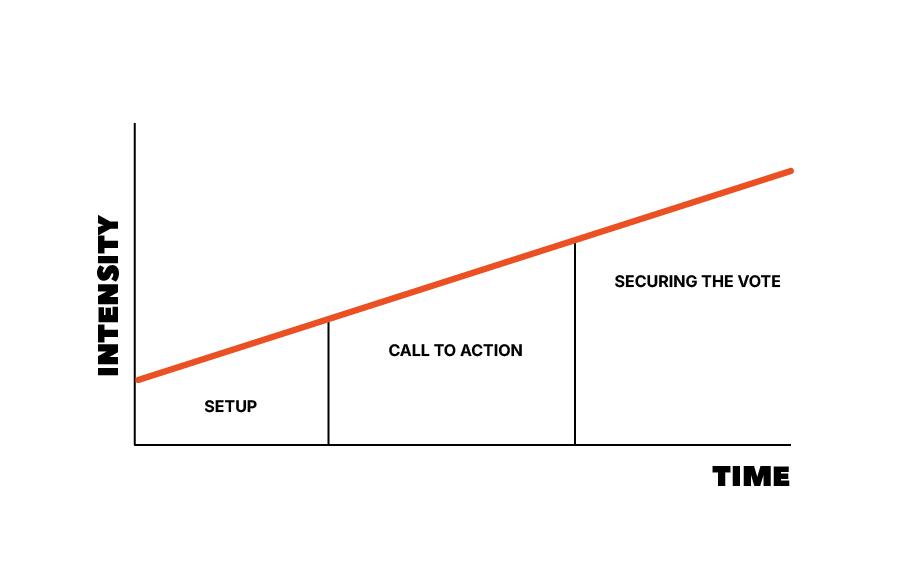
Finally, it’s important to understand the stages of a campaign and determine which challenges are priorities at each phase. The campaign plan’s design should progressively increase in terms of effort and resources.
This doesn’t mean wasting energy, but rather making it clear that building campaign strength involves key actors and varying intensities at each level.
Ideally, overall growth should start with “hard” voters (those already committed and following the project from the beginning) and then expand across all dimensions: number of volunteers, votes, resources, implementation activities, and more.
Every campaign is unique, and there’s no single formula. Still, three classic stages are generally recommended for the overall structure:
- Introducing the candidate and establishing the need for change
- Calling to action and mobilising people to achieve change
- Creating a sense of urgency that pushes vote consolidation
Disclaimer: Our global content is produced from the knowledge network of many different people and geographies. Always research the rules applicable to your specific territory and ensure that your activities comply
Keys For Successful Campaigns

Campaigns
Three Key Factors for Successful Campaigns
Although there is no single formula for running a successful campaign, and probably every person who has coordinated a campaign has their own methods, in our experience, there are three key elements that help achieve the proposed objectives. Let’s take a closer look:

A candidate with skills and commitment:
She is willing to be the first to get up and the last to finish the day. She studies, listens, and relies on her team with dedication and humility.
These qualities are even more important than prior electoral experience or basic initial knowledge, as they form the foundation for unlocking potential through her work and commitment to the political project she represents.

A team with heart and dedication, willing to put their feet and voice on the ground:
This is a crucial element. It is important that the team has good working conditions, that each person’s dedication is valued, and that effort is recognised and rewarded.
It is essential to leverage on accumulated experience and knowledge from our political organisations, while not forgetting the value of political innovation, experimentation with new practices, and new formats that may emerge.

A well defined and shared strategy:
Intelligence. We don’t expend energy randomly. We align around a common strategy, which is understood and embraced by everyone on the team.
Finally, it is important to remember that campaigns are moments of opportunity.
They are a chance to put the political project to the test, rethink it, and strengthen it; to consolidate the discourses and practices the group has carried for a long time, aiming for social transformation. Campaigns are also opportunities for the political project to reach more ears, expand into new territories, and grow its collective building capacity, surpassing the limits of the social and community environments from which it originated. Without a doubt, campaigns are the best opportunity to test, grow, and improve as an organisation.
Disclaimer: Our global content is produced from the knowledge network of many different people and geographies. Always research the rules applicable to your specific territory and ensure that your activities comply
Building Your Campaign Team
GLOBAL
Guides

How to identify, set up and manage a team
It’s time to identify and invite the people who will dive into the electoral campaign with you. You’ve probably already thought of someone who simply has to be part of your campaign team and stand by your side. Great! This guide is here to help you do exactly that: build your electoral campaign team, organise it, and plan what each person can contribute.
Without a team (even a small one) it’s very difficult to run a strong, impactful campaign. You, as the candidate, will need to be out on the streets: meeting people, talking, listening, and mobilising voters. For that to happen, you need a trusted and committed group ready to carry out the necessary tasks.
Depending on the resources your campaign has, your team could be made up of paid staff, volunteers, or a mix of those. Below, you will find practical tips, as well as the basic campaign structure. Think about each area and find people who could fill those roles.

Deadline
Ideally, you should start thinking about your team 8 months before the official campaign begins. At the latest, 4 months before the election. Just a heads-up: by then, people with campaign experience are often already committed elsewhere. So, the earlier you start, the better.

Composition
Your team should be made up of people you trust. This space is essential to the success of your campaign. Of course, this may vary depending on whether your campaign is Basic, Ideal, or Dream Scenario. In a Dream Scenario, you may be able to hire people to work on your campaign. In that case, experience, strong negotiation skills, and careful reference checks really matter.

Value your campaign team
Everyone brings different skills. Mapping these skills is essential, as is recognising and valuing what makes each person a key part of your campaign is what will keep them motivated.

Identify gaps and weaknesses
In Basic or even Ideal campaigns, it’s not always possible to have enough people to cover every need. Some specific skills may be missing. Identify these gaps and figure out the best way to work around them.
Building your campaign team:
Team structures:
Your campaign team doesn’t need to follow a rigid, one-size-fits-all structure. Still, the more people available to help, the better. Just make sure each team member knows exactly what her role, responsibilities and managers are.
Someone to coordinate the campaign:
Try to find someone who can support you in overall campaign management. This person needs to have enough time available to follow everything closely throughout the campaign period, as well as being someone you truly trust – both her ethics and excellence.
Does anyone come to mind?
Communication:
Online and offline communication, narratives, design, and video.
You must have someone taking care of social media and overall communication.
In an ideal world, you would have a photographer/videographer/editor as team members, but you can also use volunteers for specific situations.
Mobilisation:
Territorial action, conversation circles, canvassing, and volunteer coordination. This person should have real grassroots experience and network, she is one of the most central figures of your campaign, talking to people on the ground.
Political articulation and calendar management:
Liaison with social movements and the party, defining events and actions, and managing everything needed to fill and organise the candidate’s agenda. This could be someone that serves as your executive assistant, a person with both organisational, administrative and political articulation skills.
Legal and accounting:
This area takes care of the legal and financial aspects of the campaign, including compliance and financial reporting. Many political parties already provide people to support this area, but it’s extremely important to check this carefully when negotiating with parties or deciding which one you’ll join in order to run as a candidate.
A team that dreams together
Look for people who share the same dream as you do. It is your job to keep them motivated, but they are also the people who’ll motivate you during tough moments. Campaigns are exhausting, and part of your team will likely be made up of volunteers, without pay, it’s even more crucial that they feel the campaign’s purpose. Before work begins, inspire your team so they understand they’re part of something bigger.
Transparency around roles
It’s very important that everyone knows their role in the process. Campaigns tend to have flexible structures, and people often end up doing a bit of everything, but without attention this can easily turn into chaos. Creating a minimum structure and hierarchy can help you avoid major headaches.
Campaign management
Who should you look for first?
Your campaign manager! She’s the most important person (after you) and the first one you should choose. The candidate and coordinator are a true duo during the campaign months, she is basically your right hand.
But who is this person?
Before thinking about professional skills, think about personal ones. This is someone who may, at times, need to make decisions on your behalf. So it has to be someone you respect, trust, who can listen and speak honestly.
What should you look for in her?
Think of someone who knows how to relate to people. The campaign manager will help manage the team, build alliances, and basically interact with everyone involved in your campaign.
What does she need to do?
Everything! You need to be sure she’s reliable and willing to do whatever it takes, from helping organise the physical space to accompanying you to an important meeting. Trust, my friend, is the key here.
It also helps a lot if your manager has experience with organising work. You know that friend who agrees to help before even knowing exactly what it is, and is super organised? She could be a great choice for campaign coordinator.
Reflect
- How can I run a strong electoral campaign with the team I have?
- What are the best job descriptions for each person on my team?
- Is there any gap in skills I need to look for?
Disclaimer: Our global content is produced from the knowledge network of many different people and geographies. Always research the rules applicable to your specific territory and ensure that your activities comply
Campaign Fundamentals

A few questions to drive your definitions
Defining a political platform goes far beyond policy proposals. It requires a deep understanding of who we are, what shapes us, and what values we are willing to defend in the public arena. Before outlining strategies or messages, it is essential to pause and reflect collectively on our motivations, principles, and vision. The questions below are designed to support this process of self-assessment and alignment, helping you and your team build a coherent, authentic, and grounded political project.
1. Why?
This question must be at the heart of everything and should be the first one answered. This will guide absolutely every decision you make.
- Why does this candidacy matter in this specific political and social context?
- Why are we doing this campaign?
- Why are we doing this campaign now?
- What personal and collective motivations drive us to enter this political dispute?
- What injustices or problems do we feel compelled to confront?
2. How?
Next, we need to understand how we want to do this. This will guide your work processes and culture, the team’s shared values and campaign’s goals and strategy.
- How do we want to conduct this campaign in practice?
- What principles and values will guide our actions and decisions throughout the process?
- How do we want to relate to voters, allies, communities, and even opponents?
- What kind of political culture do we want to embody and model through this campaign?
4. Who are we?
This question invites reflection on who is involved in the campaign.
- Who is part of this campaign and where does this candidacy come from?
- What is our shared history of action, struggle, or organising?
- What values, experiences, or identities unite us as a collective?
- What personal and collective experiences led us to build this project together?
5. Who will be the voice of the campaign?
Once the purpose, principles, commitments, concrete project, and the collective behind it are clear, we can decide who will be the voice of the campaign.
- Who is best positioned to represent this project publicly and politically?
- What personal qualities, experiences, and strengths support this role?
- What challenges or limitations will this person need to navigate?
- What life story and political trajectory help build credibility and connection with voters?
Tip: We recommend you make a dynamic with your leadership team to answer those questions, document and print an overview. It’s important to make it visible to every staff and volunteers so they can use these as guides to each decision. This will help you and your team feel confident and prepared to face challenges and achieve your goals.
Disclaimer: Our global content is produced from the knowledge network of many different people and geographies. Always research the rules applicable to your specific territory and ensure that your activities comply
Setting Campaign Goals

How to organise what you want to achieve?
Do you want to know whether your electoral campaign is having an impact? Defining objectives is key! Remember that objectives must have results that can be measured and compared over a defined period of time. I’ll share my favorite acronym to remember the characteristics our objectives should have:
MARTE:
Measurable – we must be able to measure our objectives numerically and/or in any way that can be documented, proven and shared
Achievable – we must be able to feasibly reach the objectives within the given timeframe, dream big but keep your feet on the ground
Realistic – the objectives must be attainable to be worth chasing in a campaign
Time–bound – objectives must include clear, practical milestones and a defined timeframe for achieving each one
Specific – objectives must be specific; general statements are not useful (usually don’t meet the time-bound category as well)
For example, I can know the size of my audience and set a weekly growth goal of 10%, and then measure whether I am meeting that objective or need to adapt my strategy. Or perhaps I want to increase my presence in traditional media, in which case I can set a goal of doing at least three television interviews per week.
These are numerical objectives that I can measure. Writing them in an Excel table and comparing results week by week always helps; there you can record whether the objectives are being met or not. I recommend setting objectives for traditional media, social media, volunteer engagement, votes secured, and also for events you organise.
Disclaimer: Our global content is produced from the knowledge network of many different people and geographies. Always research the rules applicable to your specific territory and ensure that your activities comply
Finding Your Target Audience
GLOBAL
Guides

Creating cross-segmented groups to tailor your communications
How do I define who my campaign and its messages are aimed at?
Who are you speaking to? Knowing your target audience means understanding their interests, needs, pains, concerns, and desires. This allows you to connect more effectively with your audiences and design communication that is relevant and compelling for your electoral audience.
Define your audiences

1. Identify your main audiences:
- Who are the people most likely to be impacted by your proposals?
- Who are you specifically addressing?
Think about factors such as age, gender, geographic location, educational level, race and socioeconomic background.

2. Research your audiences:
Once you have a general idea of who you want to reach, go deeper into their behaviors and needs. You should do this both by online forms and research as well as in-person meetings, knowing their neighborhoods, etc.
- What are their interests?
- What are their needs?
- What worries them?
- How do they communicate?
- What media do they consume?
- Which social networks do they use?

3. Create a persona for each audience:
Think of your audience as if it were a person and create a profile that represents them.
- What’s their name?
- How old are they?
- Where do they live?
- What do they like to do in their free time?
- Which social networks are they on?
- What kind of digital content do they consume?
- What TV shows, podcasts, or radio programs do they follow?
This persona will help you better understand your audience and create more effective messages.

4. Think about narratives for your audiences:
Once you’re clear on your audience persona, adapt your communication to their needs and interests. Use language that feels familiar and speaks to them directly. Create different narratives for different groups of people.
Below are broad examples of audiences and targeted messages.For simplicity, we have segmented audiences only by age. In practice, you should further refine each of your audiences, combining factors such as gender, geographic location, educational level, and others that are relevant to your campaign (ex. Women, of color, 25-45, X City, Y Neighborhood, High School degree, uses Instagram, watches evening news, doesn’t feel represented by politicians).
Examples:
Audience A: Young people (18–25 years)
Relevant messages:
- Animal welfare policies
- Environmental protection policies
- Employment opportunities
- Implementation of technology in public administration
- Scholarships and access to higher education
Audience B: Women (18–65 years)
Relevant messages:
- Safety
- Access to justice in cases of gender-based violence
- Support for single mothers
- Remote work
- Gender equality policies
Free medication and medical consultationsconfident and prepared to face challenges and achieve your goals.
Audience C: Older adults (60+)
Relevant messages:
- Dignified pensions
- Healthcare support
Disclaimer: Our global content is produced from the knowledge network of many different people and geographies. Always research the rules applicable to your specific territory and ensure that your activities comply
Crafting Your Campaign's Message
GLOBAL
Guides

How to build your campaign messages in line with your objectives
Campaign messages are like arrows: their trajectory must be precise, and their impact deep and effective. It’s better to launch a single, well-aimed arrow than to waste a hundred with no clear direction. Always keep in mind the specificities of the people you are addressing. Once you understand your audiences, communicating your ideas to each of them becomes much easier.
Follow these five steps to build your campaign messages:

1. Organize your proposals
Put your proposals in order, thinking of them as solutions to the problems your constituents (audiences) are facing. Organize them according to the public’s priorities and also according to the agenda you want to set to your potential mandate. Your proposals are the core of your campaign; all messages should be variations deriving from them.

2. Identify your key message
Identify the key messages or themes you will address throughout the campaign and prioritize them. You need absolute clarity on your public policy proposals:
- what do you want (and realistically can) implement that would generate meaningful change?
- How can you communicate these proposals clearly and simply?
At the intersection of your proposals and how you communicate them lie your key messages.

3. Organize your key messages
Organize your key messages into a coherent, well-structured document that includes main ideas and supporting arguments. Add relevant data and statistics to back up your messages. This document (your “argumentarium”) should serve as a research-based reference you and your team can return to whenever you need to defend or deepen your proposals. It should clearly explain why the changes you propose are necessary and outline your strategic plan for implementation. Needs (including data), proposals, and arguments all belong here. Include a section explaining why you are the best candidate for this position.

4. Create your political narrative
Remember that your unique personal experience also contributes to building solutions. Include elements about who you are and the life philosophy you want to project.
- Why are you the solution to these problems?
- What about you will motivate people to vote?
- What is your political story?
Write it as a story of struggle and achievement.

5. Create your slogan
A slogan should reflect your proposals, key messages, and personal and political story. It should be short, powerful, and capable of expressing something profound about your struggle.
Example: Colombian Vice President Francia Márquez used the campaign slogan “Vivir sabroso” (“Living well”), a philosophy rooted in Afro-descendant communities. Francia is the first Afro-Colombian woman to become Vice President, and her campaign centered her identity and the way her personal experience enriched Colombian politics. Vivir sabroso condenses a cultural and political vision grounded in a harmonious relationship with nature and the environment. It is a demand for dignity, peace, and the right to enjoy life, things that violence and insecurity have taken away from many people in Colombia. It also fills historically marginalized communities with pride. Two simple words that carry representation and proposal at once.
Key considerations when crafting messages
Identify your audience’s problems and needs
Communicate how your proposals address the real situations your electorate faces. Approach your audience with empathy and sensitivity. Alexandria Ocasio-Cortez, the youngest woman ever elected to the U.S. Congress, won her race with just five core proposals addressing the main challenges in her community. Notice how simply and clearly she presents her platform on her website.
Identify the emotions you want to evoke
Do you want to inspire hope, empathy, indignation, or enthusiasm? Emotions are powerful tools for connection. This should be defined intentionally and then reflected in language and design.
A classic example is Barack Obama’s “Hope” campaign poster: everything, from his upward gaze to the color palette and the single word, was designed to evoke emotion and possibility.
Be clear and concise
Keep messages simple and to the point. Avoid technical jargon or political language that may confuse your audience. Structure information so it’s easy to understand.
Use concrete examples
Concrete examples help people grasp your proposals. Use real cases or everyday situations to illustrate your ideas. There are always stories that represent your community’s challenges. Go out, talk to people, and find voices that embody the changes you want to make. Connect with local activists or explore digital platforms like Change.org.
Be authentic
Your messages should reflect who you are and how you think. Don’t say what you think people want to hear, say only what you genuinely believe. Authenticity builds trust. Alexandria Ocasio-Cortez’s campaign video, where she shared her life and political journey, was key to her victory precisely because of its authenticity.
Use inclusive language
Make your audience visible. Language matters. Instead of defaulting to masculine or exclusionary terms, use inclusive alternatives such as “people from x,” “the public,” or “the community.”
For example, rather than “farmers” in the masculine form, you can say “people who work in agriculture.”
Don’t underestimate your audience
While messages should be accessible, always treat your audience with respect and intelligence. People are fully capable of understanding complex proposals when they are presented clearly and simply.
Disclaimer: Our global content is produced from the knowledge network of many different people and geographies. Always research the rules applicable to your specific territory and ensure that your activities comply