Guides
Planning Your Political Campaign
About the track
The foundations of strategic campaign planning, including goal setting, target voter identification, team building, message development, and the key decisions that make campaigns win.
Campaign Planning Essentials

Electoral campaign’s stages and planning
We recommend that the strategy development considers processes, timelines, and leaders. That’s why, within campaign teams and processes, it’s important to have people who can carry out different tasks. Let’s take a look.
Basic notions for planning an electoral campaign and identifying its main stages
Intuitively, especially in highly politicised environments, there’s often an excessive concentration of skills and “person-hours” in strategy and political negotiation. At the same time, there’s little focus on tactical and operational deployment. In less politicised campaigns, the opposite tends to happen: strong operational focus with weak strategic alignment.
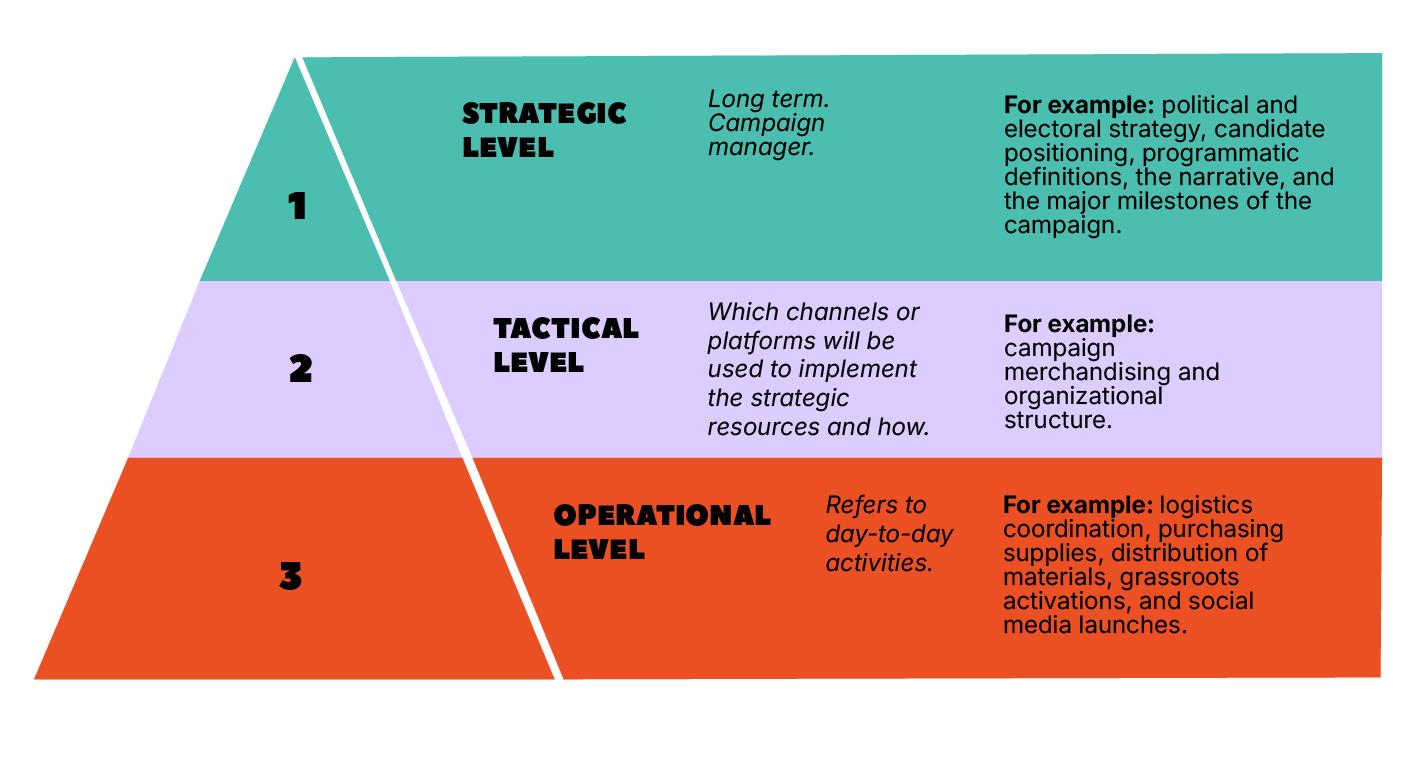
That’s why it’s important to recognise and become familiar with the three levels of strategic planning:
01
Strategic level:
This level corresponds to the most general, high-level definitions of the campaign. It guides long-term decisions. For example: the political and electoral strategy, the candidate’s positioning, programme causes and definitions, the campaign narrative, and its major milestones.
02
Tactical level:
This refers to the tactical unfolding of the strategy. It defines which channels or platforms will be used to carry out strategic actions and with which resources (the budgeting process usually sits at this level). Campaign advertising choices and even the organisational chart belong here.
03
Operational level:
This concerns the day-to-day activities that implement the tactical plan, such as logistics coordination, procurement, material distribution, territorial activations, and social media outreaches.
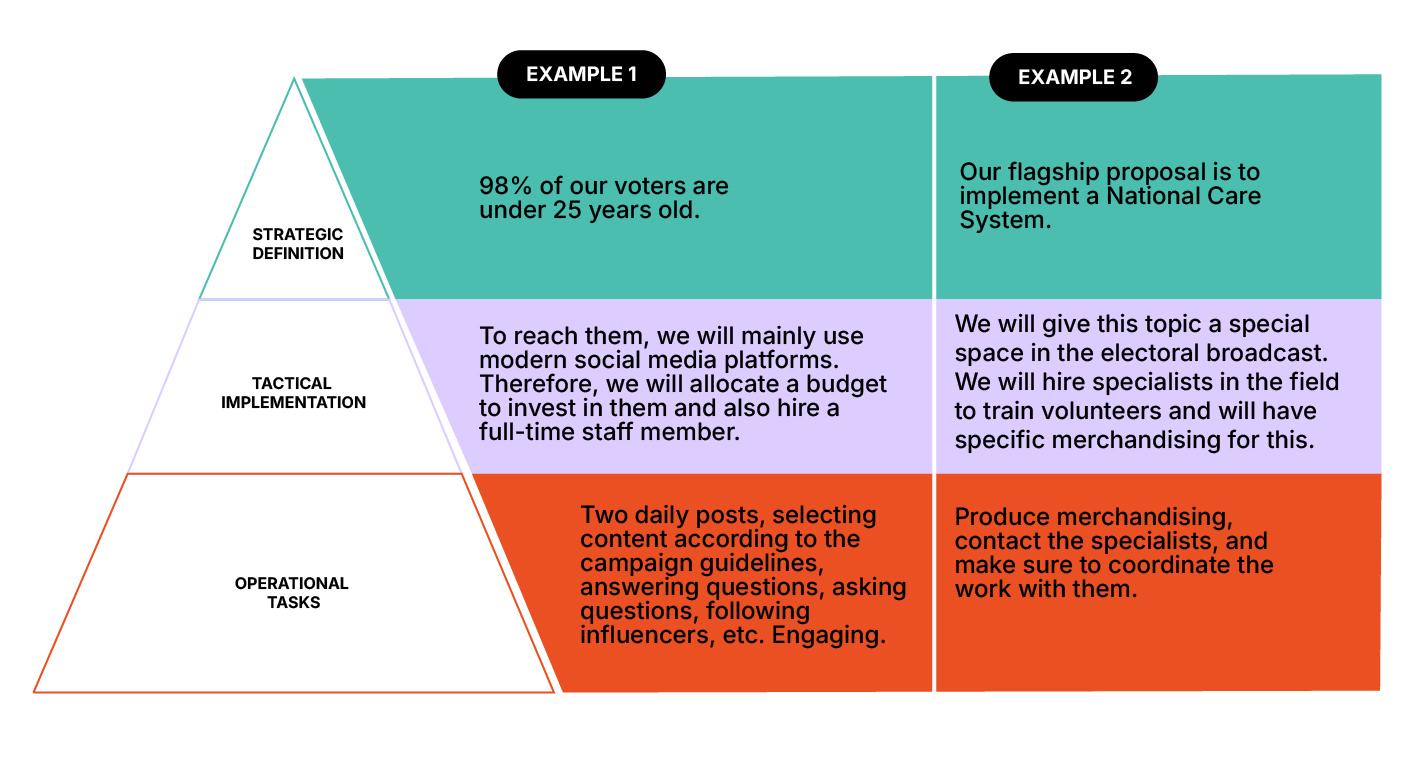
In the table below, you’ll find two examples of strategic definitions along with their tactical implementation and associated operational tasks:
| Strategic definition | Tactical implementation | Operational tasks |
| 90% of our electorate is under 25 years old. | To reach them, we’ll mainly use social media. We’ll allocate a budget for paid content and hire a full-time staff member. | Two daily posts, selecting content according to campaign guidelines, answering questions, interacting, following influencers, etc. |
| Our flagship proposal is to implement a National Care System. | This issue will have special prominence in the campaign. We’ll contact experts to train volunteers and develop specific merchandising. | Produce merchandising, contact specialists, and organise and support the work with them. |
Just as important as recognising which planning level each decision belongs to is understanding who makes each decision and where: which people? in which meetings?
Roles, rhythm, and team structure
Campaigns move at a vertiginous pace. There are many decisions to make in very little time. That’s why clearly defining roles within campaign teams (and making sure everyone is aligned) is essential. For example, if the campaign coordinator is busy ordering merchandising or handling logistical and administrative tasks, it’ll be hard for her to focus on day-to-day strategic decisions and crisis management.
Clear task and responsibility definitions are the backbone of team organisation. That’s why designing an organisational chart (and applying it properly) is so important, ensuring everyone understands their responsibilities and internal points of contact.
The “situation room”
There’s a key campaign space that must be clearly defined: the situation room.
It’s the brain of the political campaign, where strategic decisions are made on a daily basis. It can be a physical space (like an office), but nowadays it often takes the form of a leadership chat. All essential people should be part of it for the campaign to function well and for the candidate to remain relevant.
Often, this space is created informally and hastily, among friends, family members, advisors or party figures, without much clarity about roles. This can give it disproportionate and non-organic influence, disrupting internal order. To avoid this, it’s crucial to define who will be part of the situation room, as these people will play a central role in crisis management, an inevitable part of any campaign.
Campaign stages and challenges
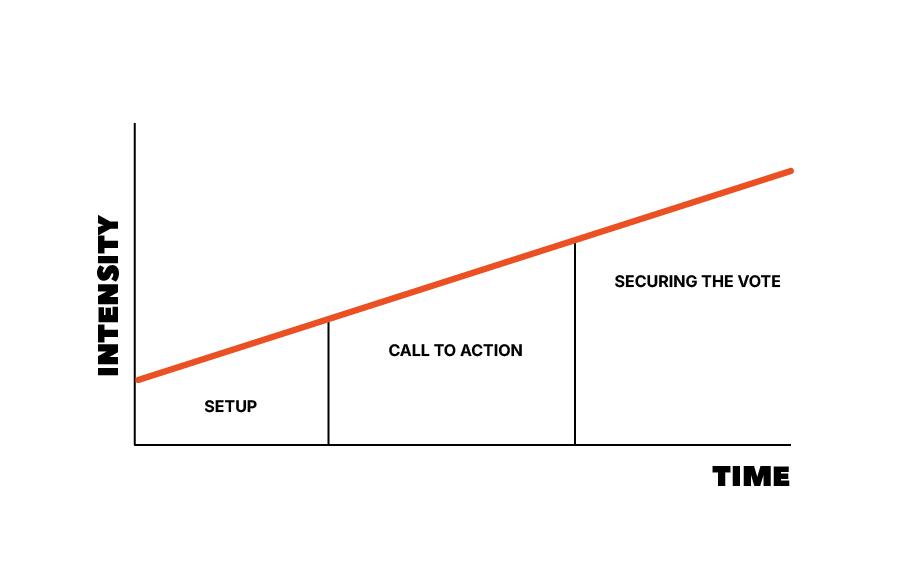
Finally, it’s important to understand the stages of a campaign and determine which challenges are priorities at each phase. The campaign plan’s design should progressively increase in terms of effort and resources.
This doesn’t mean wasting energy, but rather making it clear that building campaign strength involves key actors and varying intensities at each level.
Ideally, overall growth should start with “hard” voters (those already committed and following the project from the beginning) and then expand across all dimensions: number of volunteers, votes, resources, implementation activities, and more.
Every campaign is unique, and there’s no single formula. Still, three classic stages are generally recommended for the overall structure:
- Introducing the candidate and establishing the need for change
- Calling to action and mobilising people to achieve change
- Creating a sense of urgency that pushes vote consolidation
Disclaimer: Our global content is produced from the knowledge network of many different people and geographies. Always research the rules applicable to your specific territory and ensure that your activities comply
8 guides, 0 minutes
1.
2.
3.
4.
5.
6.
7.
8.
Guides
Guides
Guides
Your opinion is important and helps us improve our content
Was this content useful?
Would you recommend this content?

Author
Javiera Martinez
She holds a degree in Industrial Civil Engineering from PUC and an MSc in Political Science from New York University. She has experience in electoral campaigns and strategy design. Her…

Related tracks
Dados e Tecnologias a Serviço de Campanhas
Estes conteúdos mostram como usar dados, escuta social e inteligência artificial para tomar decisÃ…
6 Materials
Safety and Resilience in Politics
A dedicated space focused on care, safety, and resilience in political life, offering guidance on se…
7 Materials
Practical Tools For Political Campaigns
Ready-to-use templates, frameworks, and tools to organize and manage campaigns from start to finish …